ADAMIXTURE is a fast CPU/GPU implementation of ADMIXTURE for biobank-scale genetic clustering. .P and .Q outputs remain compatible with ADMIXTURE.
Use Cases
Connectivity and dispersal mode shape the landscape genetics of a carnivorous pitcher plant-arthropod metacommunity
Authors: Nonno Hasegawa, Asa E. Conover, Matin Miryeganeh, David W. Armitage (2026)
Institution: Okinawa Institute of Science and Technology (OIST), University of California, Berkeley
Preprint: bioRxiv (DOI: 10.64898/2026.08.09.743144)
This study investigates how landscape connectivity, dispersal mode, and environmental resistance shape genetic structure in the carnivorous pitcher plant Darlingtonia californica (cobra lily) and two of its obligate arthropod mutualists (the midge Metriocnemus edwardsi and the mite Sarraceniopus darlingtoniae) sampled across sites in Oregon and northern California.
Application:
The authors used ADAMIXTURE to estimate individual ancestry proportions across a nuclear genomic dataset of 19,166 SNPs in 199 individuals. They evaluated ancestral components across K = 2 to 15 with 5-fold cross-validation, which supported K = 3–4 as the most plausible regional clustering structure. The results revealed limited admixture across regional boundaries, supporting the central–marginal hypothesis and demonstrating that gene flow in the host plant is restricted by landscape resistance rather than geographic distance alone.
Darwin's Cats: Cat Ancestry Methods Overview
Author: Kasia Bryc (2026)
Institution: Darwin’s Ark, Broad Institute of Harvard and MIT
Report: Methods Overview (PDF) • Darwin’s Cats Ancestry Initiative
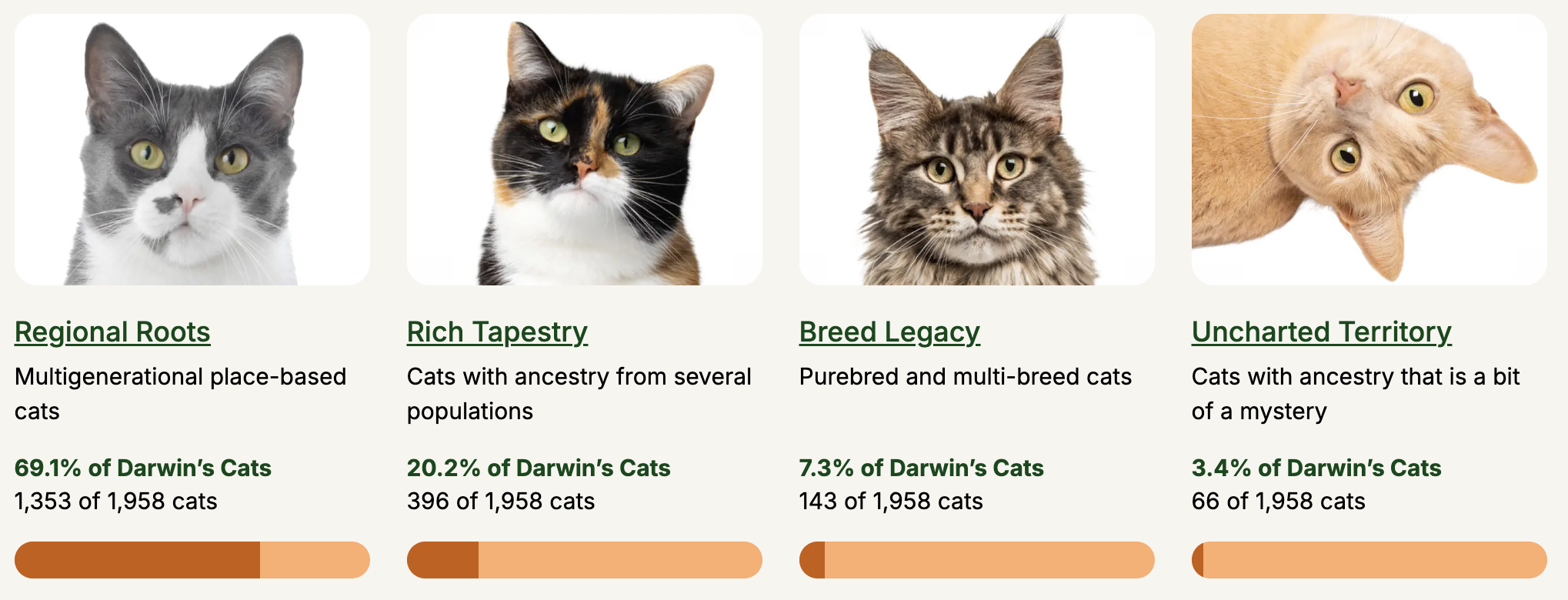
Darwin’s Cats is a community genomics initiative by the non-profit organization Darwin’s Ark in collaboration with researchers at the Broad Institute of Harvard and MIT. By analyzing low-pass whole-genome sequence data imputed against a high-coverage reference panel of 992 felines across 99.2 million variants, the project discovered that pet cat genetics in the United States is overwhelmingly shaped by geography and isolation-by-distance rather than breeds.
Application:
Darwin’s Ark uses ADAMIXTURE to model each cat’s individual ancestry as an optimal mixture across an ancestry reference panel of 591 cats spanning 42 reference populations (13 North American regional populations, 3 world regions, 21 recognized cat breeds, and wild cat species including the European Wildcat Felis silvestris) on a linkage-disequilibrium thinned panel of 155,210 genome-wide SNPs. Ancestry proportions inferred by ADAMIXTURE classify participating felines into four major ancestry cohorts: Regional Roots (multigenerational place-based cats, 69.1%), Rich Tapestry (multi-population ancestry, 20.2%), Breed Legacy (purebred and cross-breed cats, 7.3%), and Uncharted Territory (underrepresented regional populations or breeds, 3.4%).
Citation
If you use ADAMIXTURE in your research, please cite:
@article{saurina2026adamixture,
  title={ADAMIXTURE: adaptive first-order optimization for biobank-scale genetic clustering},
  author={Saurina-i-Ricos, Joan and Mas Montserrat, Daniel and Ioannidis, Alexander G.},
  journal={Bioinformatics},
  volume={42},
  number={Supplement\_1},
  pages={btag236},
  year={2026},
  doi={10.1093/bioinformatics/btag236},
  url={https://doi.org/10.1093/bioinformatics/btag236}
}
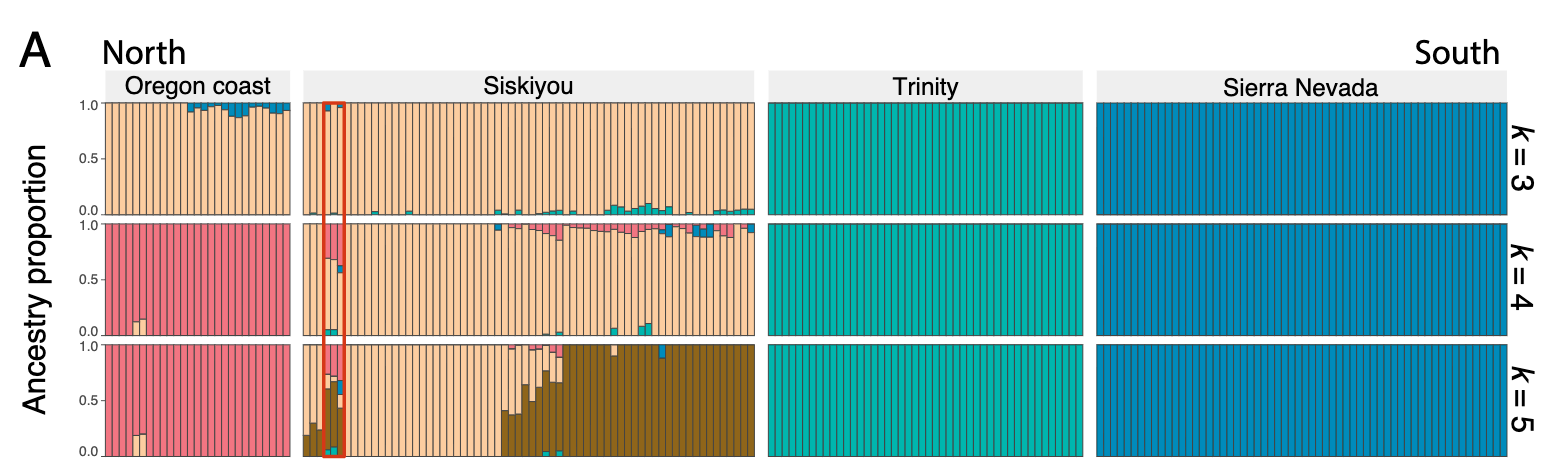 Figure: Estimated individual ancestry proportions for Darlingtonia californica from ADAMIXTURE (K = 3, K = 4 supported by 5-fold CV).